CodeRabbit Verify Launches to Close the AI Code Quality Gap
Software development teams are shipping pull requests faster than ever before, creating a severe quality assurance bottleneck across modern engineering organizations.
On November 18, 2026, CodeRabbit launched Verify into public beta—an autonomous agentic application testing layer designed to validate code written by AI coding agents.
According to Futurum Research, 46.8% of enterprises already use artificial intelligence for code generation and debugging. While coding agents generate pull requests in minutes, manual testers and static unit tests struggle to verify real user workflows at the same speed.
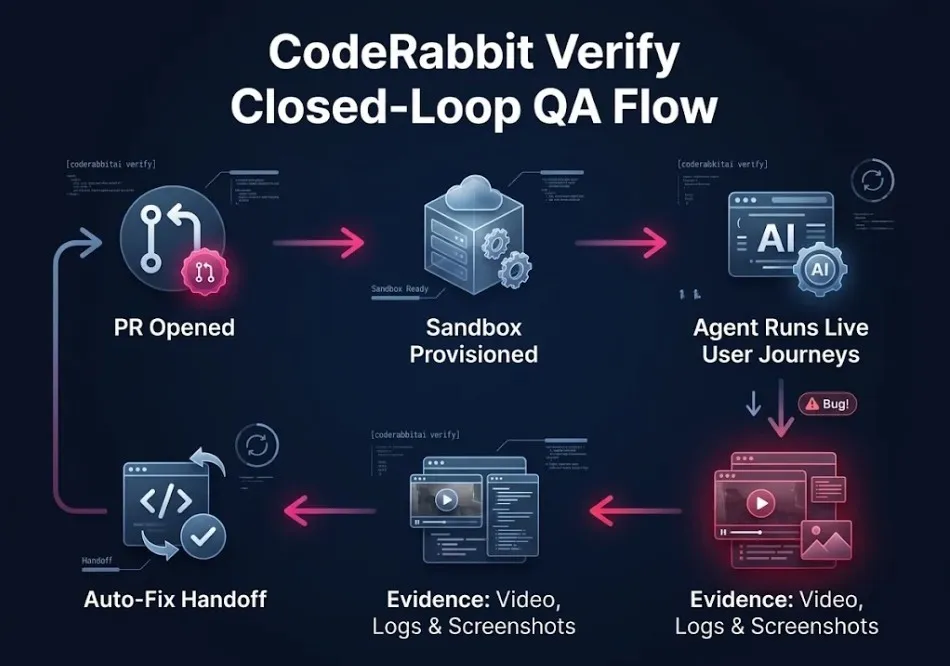
CodeRabbit Verify bridges this gap by spinning up isolated sandboxes, executing live user journeys in a browser, and capturing visual proof of functional bugs before code reaches production.
For quality engineers adapting to autonomous pipelines, building hands-on proficiency in AI-powered software automation testing is quickly becoming an essential career requirement.
How CodeRabbit Verify Changes Pull Request Validation
Static code reviews read source diffs, and unit tests verify isolated functions in memory. Neither approach catches broken UI wiring, misconfigured redirects, or hidden checkout buttons on a live application.
To catch runtime regressions automatically, CodeRabbit Verify introduces five core capabilities across the software development life cycle:
1. Autonomous Sandbox Provisioning
When a developer opens a pull request or comments @coderabbitai verify, the agent inspects repository dependencies and startup scripts. It provisions an isolated cloud sandbox, configures side services, starts the web application, and verifies health readiness away from production environments.
2. Context-Aware Scenario Synthesis
Verify does not rely solely on rigid, pre-written test scripts. Instead, it analyzes commit diffs, source code, documentation, and prior code review findings to generate targeted test scenarios tailored to the exact pull request changes.
3. Live Browser Execution and Reusable User Journeys
Beyond single pull request checks, engineering teams can save critical workflows—such as user sign-up, account settings, or checkout flows—inside a central Journey Library. Teams can execute these reusable journeys on demand or on automated schedules to guard against silent regressions.
4. Auditable Evidence and Bug vs. Blocker Separation
Every test execution captures full browser session recordings, step-by-step screenshots, and runtime logs. Crucially, Verify separates true product bugs from environment blockers—such as missing API credentials or incomplete test data—so engineers do not waste hours chasing false alarms.
5. Closed-Loop Remediation with Coding Agents
When Verify uncovers a functional defect, it attaches the reproduction steps and session recording directly to the pull request or creates a tracked ticket in Jira or Linear. Developers can then hand that structured evidence directly to CodeRabbit Agent or their preferred coding agent to generate a verified patch.
Traditional Static Review vs. Agentic Application Testing
Moving from diff-only inspection to runtime verification changes how teams catch defects before release:
|
Evaluation Factor |
Traditional PR & Unit Testing |
Agentic QA (CodeRabbit Verify) |
|
Execution Environment |
Static code diffs and mocked unit runners |
Live web application inside an isolated sandbox |
|
Defect Detection Scope |
Syntax errors, isolated logic bugs |
Broken user journeys, UI wiring, runtime regressions |
|
Evidence & Debugging |
Text stack traces and console logs |
Browser video recordings, screenshots, reproduction steps |
|
Environment Blockers |
Often reported as ambiguous test failures |
Explicitly flagged as blockers with suggested fixes |
|
Remediation Workflow |
Manual reproduction and ticket creation |
Direct handoff to coding agents and Jira/Linear sync |
What Autonomous Verification Means for QA Engineers
The rapid arrival of agentic verification tools confirms a broader shift across the software industry: repetitive, script-heavy validation is moving toward autonomous orchestration.
However, enterprise research notes that human governance remains non-negotiable. Autonomous agents still require human review before merging fixes, masked synthetic data in sandboxes, and skilled quality architects to define business-critical user journeys.
Understanding how autonomous execution pairs with human intuition is critical for modern test teams, a balance explored in depth in our guide on Manual Testing vs Automation Testing.
Furthermore, while agentic tools verify functional user journeys, high-traffic applications still require dedicated load and latency validation—outlined in our breakdown of what is performance testing.
For testers looking to transition into modern quality engineering roles, exploring practical software testing courses, reading our guide on what is agentic AI in software testing, or browsing all courses at AppTekLab provides a structured roadmap for mastering agentic QA workflows.
Frequently Asked Questions (FAQ)
What is CodeRabbit Verify?
CodeRabbit Verify is an agentic application testing and quality assurance tool launched into public beta on November 18, 2026. It deploys web applications into isolated sandboxes to test pull requests and user journeys automatically with browser recordings and screenshots.
How does CodeRabbit Verify differ from standard unit tests?
Unit tests verify isolated functions in code without running the full user interface. CodeRabbit Verify spins up the running web application in a sandbox and navigates real user flows in a browser to catch integration, UI, and wiring bugs that unit tests miss.
Which platforms support CodeRabbit Verify during public beta?
During its public beta, CodeRabbit Verify supports web applications hosted on GitHub Cloud, GitLab.com, and Bitbucket Cloud repositories connected to CodeRabbit Cloud. Native mobile apps and self-hosted Git servers are not supported in the initial beta.
Will agentic QA tools like CodeRabbit Verify replace human testers?
No. While agentic QA accelerates pull request verification and catches functional regressions automatically, human QA engineers remain essential for exploratory testing, usability evaluation, test data governance, and verifying complex business logic.
Preparing Your Pipeline for Agentic Quality Assurance
As AI coding agents accelerate software delivery, quality assurance can no longer rely solely on manual regression cycles or static code reviews. Tools like CodeRabbit Verify demonstrate that runtime, evidence-backed agentic testing is quickly becoming standard practice in modern DevOps pipelines. Engineering teams that pair autonomous verification with strong QA architecture will ship faster without sacrificing product reliability.