Sub-10-Minute CI/CD Test Gates: Cloud Cost Optimization 2027
Enterprise engineering budgets face severe pressure as cloud compute bills spiral out of control across modern delivery organizations.
Recent engineering productivity data reveals that bloated 45-minute continuous integration test cycles drain developer momentum and stall deployment velocity.
At the same time, companies routinely spend thousands of dollars every month on idle virtual machine runner minutes.
Engineering leadership is responding decisively across global technology hubs.
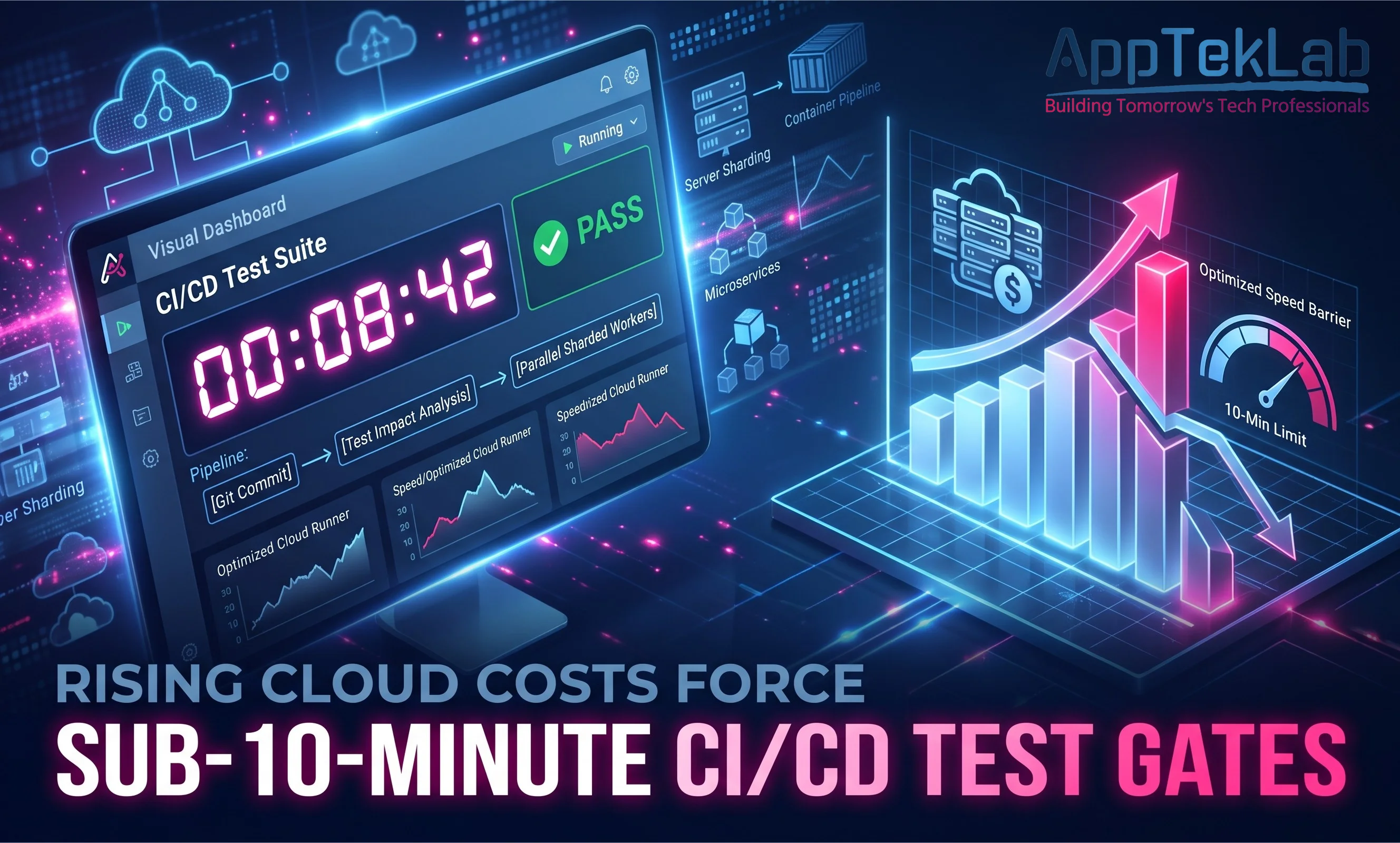
Chief Technology Officers now enforce strict sub-10-minute automated release gates across active continuous integration and continuous deployment pipelines.
Development teams that exceed this runtime threshold must actively refactor their test suites to stay compliant.
Software departments are replacing monolithic end-to-end regression suites with sharded microservice validation.
To maintain release velocity, quality teams are pivoting toward distributed runners and AI-powered software automation testing to validate code changes within seconds.
CI/CD Pipeline Bottlenecks: Why Build Speed Is Now a Financial Metric
Optimizing ci cd test execution speed has shifted from an internal convenience into a top-tier operational financial metric.
When large engineering teams deploy multiple pull requests daily, sluggish test suites create severe deployment bottlenecks.
Engineers sit idle while waiting for pull request verification gates to pass before merging features.
This friction prolongs sprint cycles, increases developer context switching, and drives up cloud billing metrics.
To satisfy strict sub-10-minute deployment gates, technical teams are eliminating four foundational infrastructure bottlenecks:
+-------------------------------------------------------------------------+
| Modern Fast CI/CD Release Gate Pipeline |
| |
| [Git Commit] ──> [Test Impact Analysis] ──> [Parallel Sharded Workers] |
| │ |
| ▼ |
| [Release Deployment Gate] <── [Pass: < 10 Mins] <──+ |
+-------------------------------------------------------------------------+
1. The Financial Drain of Serial UI Regression Runs
Legacy testing architectures execute UI test scripts sequentially on a single virtual cloud machine.
Running hundreds of complex browser tests sequentially can take more than an hour to finish.
Every extra minute of compute consumption on platforms like GitHub Actions or AWS CodeBuild adds direct billable expense.
Engineering organizations are phasing out single-thread test runners in favor of parallelized engines like Playwright and pytest-xdist.
Executing tests concurrently across multi-core virtual machines slashes total execution durations by more than half.
2. Smart Test Selection and Test Impact Analysis
Running an entire regression test suite for a minor front-end stylesheet adjustment wastes compute capital.
Modern continuous integration pipelines now utilize intelligent Test Impact Analysis (TIA) engines.
These predictive engines inspect incoming Git commit diffs to determine which application files were touched.
The runner maps code adjustments directly against relevant test cases and executes only affected test scenarios.
Skipping unaffected modules reduces build durations by up to 70% without sacrificing system quality.
3. Containerized Test Sharding Across Ephemeral Runners
Rather than burdening a single server, modern DevOps teams split test suites across lightweight Docker containers.
A test suite containing 1,000 automated scenarios is split evenly across ten isolated worker containers.
Each ephemeral worker processes its allocated subset simultaneously in the cloud environment.
This containerized approach reduces a 50-minute test suite down to five minutes of total elapsed wall-clock time.
Understanding how backend architectures respond under heavy parallel execution is essential, as detailed in our guide on what is performance testing.
4. Eliminating Flaky Retries That Double Cloud Costs
Flaky tests are automated assertions that fail intermittently without any underlying software defect.
Many engineering setups configure automated retry flags to bypass these intermittent failures.
Rerunning failing tests multiple times doubles or triples runner compute consumption without fixing root defects.
Modern quality organizations now quarantine unstable tests into non-blocking monitoring branches automatically.
This ensures broken element selectors and network timeouts do not inflate monthly infrastructure bills.
Pipeline Performance Benchmarks: Legacy vs. Optimized
Adopting sharded testing architectures delivers tangible improvements in deployment frequency and cloud compute efficiency:
|
Pipeline Metric |
Legacy Serial Pipeline |
Optimized Ephemeral Pipeline |
Impact / Improvement |
|
Average Suite Duration |
45 to 60 Minutes |
6 to 9 Minutes |
85% Faster Pipeline Feedback |
|
Execution Architecture |
Single Heavy VM Runner |
Multi-Container Sharding |
High Resource Concurrency |
|
Compute Waste per Run |
High (Full Suite Executions) |
Low (Impact-Selected Runs) |
Up to 60% Cloud Cost Savings |
|
Flaky Retry Overhead |
3x Automatic Retries Enabled |
Quarantined Non-Blocking Suites |
Zero Wasted Compute Cycles |
|
Daily Release Frequency |
1 to 2 Deployments / Day |
10+ On-Demand Releases / Day |
Continuous Feature Delivery |
The Upskilling Shift: Why SDETs Must Master DevOps Infrastructure
The demand for lightning-fast test execution has permanently transformed the role of Quality Assurance Engineers.
Engineering managers no longer measure the value of an SDET solely by the number of scripts written.
Modern quality professionals are evaluated on pipeline efficiency, script resilience, and infrastructure cost management.
A successful quality assurance framework requires knowing when automated scripts add value versus when human exploration is required.
Teams must balance these testing trade-offs, as outlined in our analysis of Manual Testing vs Automation Testing.
Aspiring testers can build foundational test design skills by enrolling in a practical manual software testing course.
Engineers looking to master Docker containers, runner sharding, and CI/CD gates can explore industry-focused software testing courses.
Reviewing the technical curricula across all courses at AppTekLab provides the engineering skills required to build efficient test infrastructure.
Frequently Asked Questions (FAQ)
What is the primary cause of slow CI/CD test execution speed?
The primary causes are serial execution of UI browser tests, monolithic database seeding steps, and running full regression suites for small code changes without test impact analysis.
How does test sharding reduce pipeline execution time?
Test sharding divides a large automated test suite into smaller, balanced subsets. These subsets run concurrently across multiple containerized cloud runners, completing extensive testing runs in minutes.
Can fast CI/CD automated gates replace exploratory manual testing?
No. Fast automated CI/CD release gates validate critical functional regressions and API schemas. Skilled manual testers remain essential for evaluating real-world user journeys, visual presentation, and subjective edge cases.
How do flaky tests inflate cloud infrastructure bills?
When automated CI runners encounter flaky assertions, automatic retry mechanisms rerun the entire test script multiple times. This unnecessarily consumes billable runner minutes and delays deployment queues for the entire engineering organization.
Strategic Takeaway for Modern Engineering Teams
Sub-10-minute CI/CD release gates represent the new operational standard for agile software delivery.
Organizations that ignore slow test execution suffer from escalating cloud bills and sluggish developer productivity.
By adopting test impact analysis, containerized parallel sharding, and strict flaky test quarantining, engineering teams protect capital while deploying quality software at scale.