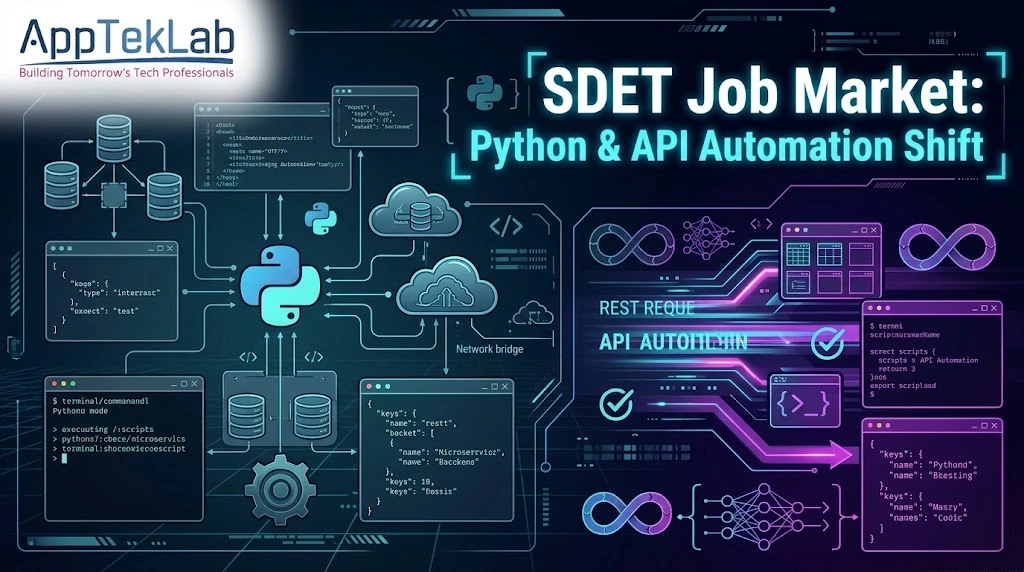
SDET Job Market: Python & API Automation Demand Surges
Enterprise technology hiring data reveals a dramatic 38% surge in software engineering job postings requiring Software Development Engineers in Test (SDET) to demonstrate proficiency in Python and automated API testing.
The hiring shift follows aggressive restructuring across software organizations phasing out isolated, manual quality assurance gates. Engineering departments now mandate candidates capable of validating distributed microservices and maintaining automated CI/CD deployment pipelines.
SDET Job Market Evolution: Why Backend Automation Dominates Hiring
The demand for software quality professionals is expanding, but the required technical baseline has permanently changed. Organizations adopting continuous delivery cannot accommodate multi-day manual release cycles.
Below is a breakdown of the core market drivers redefining QA hiring requirements across tech companies:
1. The Decline of Isolated Manual Verification
Stand-alone manual testing teams are rapidly being replaced by cross-functional quality engineers embedded directly in development squads. While human inspection remains critical for visual aesthetics and usability, companies no longer hire dedicated personnel solely for repetitive feature verification.
Aspiring testers must understand how to evolve their careers, a progression detailed in our industry guide on how to become a software tester.
2. The Dominance of Python in Test Automation
While Java historically dominated enterprise test automation, Python has become the preferred language for modern SDET positions. Hiring managers cite three primary reasons:
- Rapid Script Authoring: Python's clean syntax allows test engineers to build automation suites in fewer lines of code.
- Rich Library Ecosystem: Native support for libraries like pytest, requests, and httpx makes API validation fast and maintainable.
- Data and AI Compatibility: Python seamlessly integrates with autonomous testing tooling and machine learning pipelines.
Candidates starting their testing journey can master these fundamentals through a structured manual software testing course before transitioning into object-oriented programming tracks.
3. API-First Architecture Over Fragile UI Testing
UI-driven automation often results in slow, flaky pipelines when applied to dynamic web applications. Enterprise engineering teams increasingly prioritize API and contract testing at the microservice layer to detect defects before UI integration.
SDET job descriptions routinely demand practical experience in:
- Mocking HTTP endpoints and validating RESTful/GraphQL schemas.
- Payload validation, authentication token automation (OAuth2/JWT), and status code assertions.
- Database state verification and asynchronous messaging queues (Kafka, RabbitMQ).
4. Cloud Runner CI/CD Pipeline Orchestration
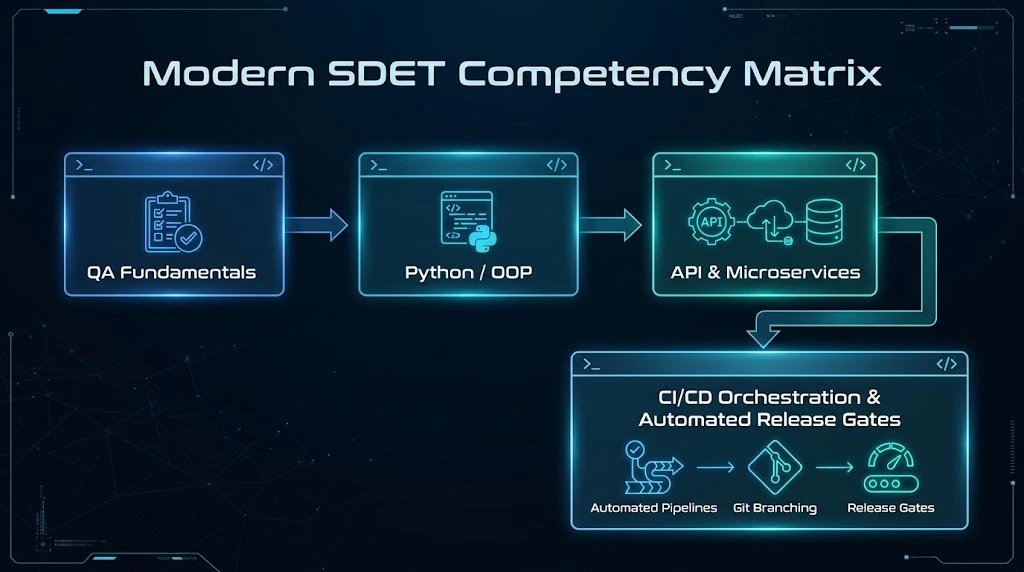
Enterprise teams expect modern SDETs to manage test infrastructure directly within CI/CD pipelines. Job listings require hands-on experience orchestrating automated parallel test suites within GitHub Actions, GitLab CI, or Dockerized runner fleets. Engineers who can minimize pipeline execution times while maintaining high code coverage command top-tier compensation packages.
Hiring Requirements: Traditional QA vs. Modern SDET
|
Attribute |
Traditional QA Role |
Modern SDET Role |
|
Primary Focus |
UI feature verification, test cases |
Microservices, API contracts, pipeline reliability |
|
Core Languages |
Basic SQL, minimal scripting |
Python, TypeScript, Java (OOP proficiency) |
|
Tool Stack |
Jira, TestRail, manual Postman |
PyTest, Playwright, Docker, CI/CD runners |
|
Execution Layer |
Browser UI and physical devices |
Headless microservice pipelines, REST APIs |
|
Defect Isolation |
Step-by-step bug reports |
Stack trace analysis, container logs, code-level fixes |
|
Market Demand |
Declining across enterprise orgs |
Up 38% year-over-year |
How Quality Engineers Must Upskill to Stay Competitive
The division between developers and test engineers is narrowing. Professionals who adapt to programmatic test architectures and microservice validation are advancing into high-impact engineering leadership roles.
Understanding how manual exploration pairs with automated test architecture is essential for any modern QA team, as detailed in our analysis of Manual Testing vs Automation Testing.
Furthermore, high-throughput backend services require continuous load and latency validation. QA engineers must understand how systems behave under intense concurrency, which is explored in our technical breakdown of what is performance testing.
To build full-stack QA automation capabilities, professionals can explore comprehensive software testing courses. Those looking to leverage autonomous CI assertions and dynamic test generation can advance their skills through AI-powered software automation testing, or review the full curriculum across all courses at AppTekLab.
Frequently Asked Questions (FAQ)
What is driving the 38% surge in SDET roles requiring Python?
Python's rapid syntax, extensive API testing ecosystem (pytest, requests), and direct interoperability with modern cloud pipelines and AI automation tools have made it the most efficient language for test automation development.
Can manual testers transition directly to an SDET position?
Yes, but the transition requires disciplined technical upskilling. Manual testers must learn object-oriented programming concepts, version control (Git), automated API frameworks, and continuous integration pipelines to qualify for SDET roles.
Why are companies prioritizing API testing over UI automation?
API tests run in milliseconds, require significantly fewer server resources, and are far less flaky than browser-based UI tests. Catching defects at the service layer enables development teams to ship code faster and more reliably.
Do SDETs need to write production application code?
While SDETs rarely write core application features, they write production-grade test software, mock backend servers, build CI/CD automation runners, and frequently submit pull requests to fix application defects discovered during pipeline runs.
Strategic Verdict for Software QA Careers
The software testing market is shifting decisively toward programmatic quality engineering. Organizations no longer fund isolated manual testing silos when automated pipelines can validate thousands of API endpoints and regression workflows in seconds. QA professionals who master Python, API automation frameworks, and CI/CD orchestration will capture the strongest career opportunities and highest compensation tiers across modern enterprise engineering teams.